Wednesday, January 30, 2008

Snow in Amman

While I was working last night the wind was howling outside. There are a couple of tall thin cypress trees about 20 feet from our back deck that kept snapping against the railing. I had threaded the internet cable through the sliding glass door and so I was getting a steady breeze in my work space in the living room.

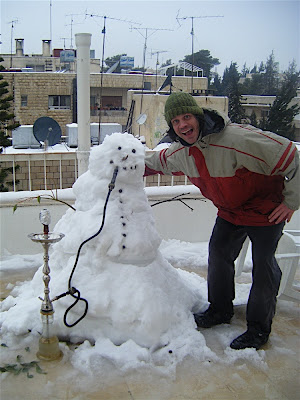
We woke up this morning to about a foot of snow. It was pretty much little slushy balls almost exactly like raw material for slushies. Or for Farheed the snowman:


There are a couple of snow plows in this city of 2 million, but most of the people seem to call it a day off.

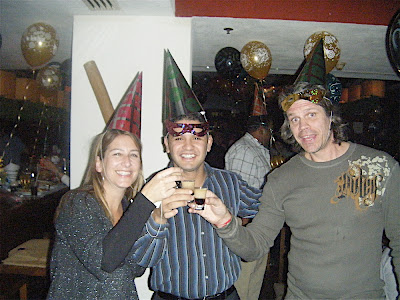
Going back a month, to new years, we got to go into the Intercontinental hotel because of Ann's coworker Fires. Its hard to get into these parties because they need to do a security check on everyone who gets in. But Fires was a former bartender there, so we managed to get fast-tracked:


Tuesday, January 22, 2008

Today: by Ann

Hope your holidays were Merry .Here's to a 2008 filled with Peace and Happiness to all of you.

Reed and I spent our Christmas holidays in the Occupied Territories (Jerusalem and West Bank) and in Tel Aviv (Israel). We were in Bethlehem on Christmas Eve and stood in the very spot where Jesus was born (true story).


At sunset we gazed over Shepherds Fields and tried to imagine what the voices of those angels who were heard on high sounded like as they announced the birth of the baby Jesus but it was really hard because the Israeli construction crews were hammering away.


Busy little elves building illegal settlements. What would Jesus say about the flagrant violation of UN Resolution 242? (WWJSAFVUN242?).

Not sure who promised this:


Thank God George Bush showed up to make peace in the Middle East. He's only been in office for 7 years.

My job is pretty amazing. Today I chatted with a former aviation engineer who had visited Seattle in the late 70's. His host from Boeing took him Sockeye fishing in the Sound and their dinghy deflated and they had to be rescued. It felt surreal to be having this conversation with a refugee en route to resettlement in Utah.
Words like Mosul and Anbar have taken on new meaning as there are faces and stories to go with the names of these places. I have met engineers, doctors, lawyers, librarians, cartographers and artists. The stories are sad and heartbreaking but as always there is a whole lotta hope in the room that the US will offer a new start in life. I try to feel hopeful too- that people will be kind to them and recognize what they have been thorough and not call them terrorists and beat them up at the 7-11. And that all the lost husbands, wives, parents, children, neighbors, and limbs are not in vain but of course we all know that nothing will ever be worth it.

Meanwhile we work out at our swanky gym across the street from Starbucks and Bennigans. On TV I watch Oprah, Dr. Phil and Shaq's Big Challenge (the latter being my favorite). Hummers careen through neighborhoods of McMansions that would make Carmela Soprano swoon. There is still the odd empty lot with a few Bedouin families and their grazing sheep but soon they will be gone as the Gulfies build their summer homes in Amman to escape the heat and the mall craze continues. We go to dinner parties with relief workers where conversation topics include the rising land costs in Kurdistan and the best carpet shops in Damascus. Our friends are Palestinians, Circassians, and Assyrians-not to mention Serbian, American, Italian and Romanian. I love the blue, blue sky and the olive trees and the kindness and complexity of the Arab culture. It's a fantastic place to be at a pivotal moment in history .

We are excited for spring (it's snowing today!)


and more days at the Dead Sea wallowing in the mud. In a few weeks I'll go to Cairo for work so we will spend Reed's birthday in Egypt.

Lots of people ask how to help. The resettlement agencies always need help-always. Many Iraqis are very highly educated and skilled... if you would like to help with job or financial assistance I can put people in touch with an agency in any city in the US. And of course the Burundians are still en route-I was interviewed for this article in the Des Moines Register: http://www.desmoinesregister.com/apps/pbcs.dll/article?AID=2008801130331

As always Reed updates the blog and if you click on a photo it will take you to the gallery: http://blog.reedko.com/


So here's to Peace on Earth. Let's hope that it actually materializes this year- Inshallah.
Mucho love, Ann

Friday, January 18, 2008

Bethlehem : The House of Meat

Bethlehem: The House of Meat

Beit Layhm. It means the house of meat. But we just think it means where Jesus was born. From Israel, Jerusalem, to get to Bethlehem, you have to go through a check point. There is a wall. A huge wall, 40ft high in places, made of steel reinforced concrete sections that were maybe made somewhere else to preclude terrorist involvement in the manufacture and dropped into the ground and linked by giant helicopters. It is very grey and ominous, as we approach on Christmas eve, with nary a red or green light. You can see the lights in the watchtowers, but they aren't very festive, being spots to ease the aim of snipers picking off suspected destroyers of peace. Not very festive at all. But still, hope abides, because its quiet and it looks like we can all get along for one more day.

The taxi driver from Jeru drops us off for 20 shekels at the cattle gate and we weave through it gazing at the razor wire. Like sheep making our way to slaughter we wander into the building made of half inch thick rumpled steel. Just like at the border with Jordan, all the checkpoint officers are women. They are so bored. So bored, and still they ask the cursory questions and try to see if your eyes dart when you answer.

And I make the bahahahah sheep sound as we scuttle thru the turnstile. But its pretty grim here, and no one laughs. The grimness doesn't wear off for a while, because we quickly cop to the fact that there is some active oppression going on here.

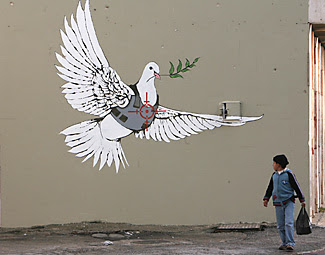
And the grafitti on the bethlehem side of the wall confirms it.

Sunday, January 13, 2008

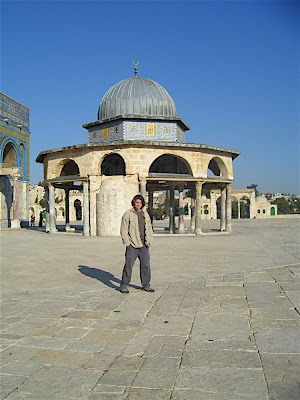
Temple Mount

We didn't expect so many people in Jerusalem to speak Arabic. 9 of 10 Taxi drivers were Palestinian, 1 was Israeli. It depends where you catch the Taxi. The Arabic taxi drivers said that a lot of Hebrew words sounded like Arabic. That the languages came from the same root. Proto-semitic, I think is the root language.

The rock is under the golden dome behind us:


Jerusalem is a city with a walled city inside that has inside of it the core of three world religions.


And that part is very quiet and hard to get to if you look a certain way or can't answer questions a certain way or betray a certain bent. But still its way too easy to get there. Ariel Sharon got there and 3000 people died.

Inside the Mosque that was built on top of the ruins of the second temple (destroyed 70 AD by the ROmans) that was built on the ruins of the temple of Solomon (destroyed ~500bc by the Babylonians, when the Jews were first exiled from Israel), there lies a rock.

This rock is where Mohammed ascended to heaven for a day and got the stories from the Angels that we call the Q'uran.

This rock is where Abraham checked the mortal descent toward the throat of
his son of a sacred knife. When the Ram appeared. Jews say that son was Isaac, Muslims say it was Ishmael.

This is the Rock where Jacob dreamt of a ladder where angels went up and down from here to heaven.

Some say this is the rock where creation began.

I always thought that the second temple was utterly destroyed except for the western wail (wailing wall), but I read somewhere that all four walls remain and a number of pillars. They call it the wailing wall, maybe, because the Jews mourn the destruction of the Temple.

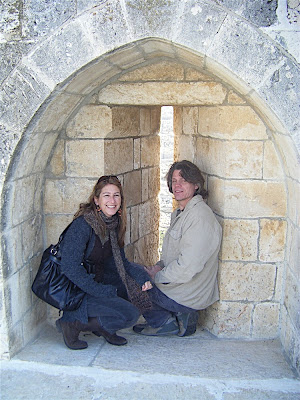
Here's us squatting near the east wall:


So we were standing at the entrance to the dome and a guy was sitting on a plastic deck chair there, so we figured he was some kind of guard. There are doors on each side of the dome but we didn't try them because nobody else was, until we got to the western side where we saw people going in, but they were obviously Muslim. I thought the guy was a guard, but it became pretty apparent that that wasn't the case when he went to have a smoke and left his 6 year old son at the door while he meandered over and chatted with the guy sweeping cigarette butts up off the holiest site in the world. We went to talk to him anyway to see if it was OK to go in, about the same time a guy with a Yankees baseball cap was talking to him. He had some English, but I picked up "Blame king Hussein" and "Forbidden" and "welcome". So we decided not to go in, not to risk offending anyone. But we talked to the guy in the Yankee's cap and he kind of moved his toe around in a circle on the ground and pointed, and then indicated the whole whole area saying "You could pose as a muslim and go in, but not a good idea, really. This piece of real estate is the most contested land in the world right now. Right here. War and destruction over the rock of creation. I don't know why that guard was saying 'blame king Hussein'". I tried to interject here that Hussein of Jordan made the Mosque off limits to no Muslims but Yankee hat was on a roll.
So the current King of Jordan, Abdullah is the son of Hussein who is the grandson of King Abdullah, who was assassinated pretty close to where we were standing on the Temple Mount because, they think, some Palestinians thought Abdullah was trying to negotiate peace with Israel. Always dangerous work. Work his grandson eventually completed.

So we left the Temple Mount and made our way to some bakery in the Christian quarter. We'd been hanging out with a couple from Florence who were working in Jordan since 6:30 am, and I knew that none of us had eaten yet, so I figured this would be breakfast. Coffee and pastry for everyone else, but by God breakfast for me. Or brunch, for it was well nigh on noon. Hummous and pita.

So we went back to the Hotel, it was 12/23. On Christmas eve we planned on going to Bethlehem.

Tuesday, January 8, 2008

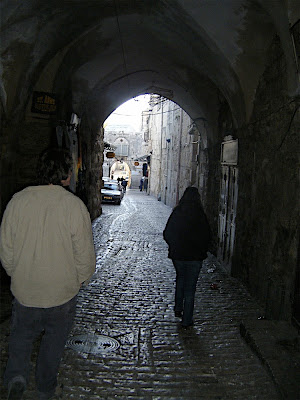
Coming into Jerusalem, we hopped a bus heading for the Damascus Gate.


It was December 23rd, apparently a pretty high traffic day in Jerusalem. The last day of the Islamic Eid and the beginning of some thick Christian inflow. We had a booking in the 7 Arches Hotel which they lost, which didn't surprise either one of us at all. The hotel had the ambiance of an institution like, say, the Department of State in D.C. Perched on the top of Mount Olive, where somewhere in the bible it says the Angels go for vacation, it commands a splendid view of Jerusalem. This is totally true.


What they don't tell you is that there are 197 rooms and only 7 enjoy this view. Those seven are all booked. They also don't mention that the comforters on the bed are so worn the frigging cotton is drooling through the liner. Threadbare. Before I get a chance to see what kind of holy book is in the drawer, Ann peels out of the room and back down the hall, the afterimage of her approbation momentarily burned into my retinas.

We check into the Ambassador, there is no holy book in the drawer.

From here it is a 15 minute walk past the American Colony Hotel to the walled part of Jerusalem. Five out of six world religions agree: This is the part where a lot of significant events occurred. Stuff like the 14 stations of the cross.


We walked by most of these stations but surprise! There is some argument about where they are between protestants and Catholics.

Wouldn't it have been cool to go to every station and take a picture of one of us posed there? Wouldn't it have been cool if we even walked to every station and considered for a moment what happened there? Yeah probably. We got to some:

Across from the first station:


Near the second:


I was surprised by how many people spoke Arabic in Jerusalem. In the taxis, for instance, we had 9 Arab taxi drivers the whole time we were there and 1 Israeli taxi driver.

Sunday, December 23, 2007

Into Israel

Left Amman around 9am. Had some last minute decisions like, do we bring the guidebook to Israel? It's called Palestine, which is what most of the Middle East Countries call most of Israel. Ann couldn't find a book about Israel in Amman that didn't call it Palestine. But, we reasoned, if we brought a book called "Palestine", would they let us in? We had no idea, so we left it behind.

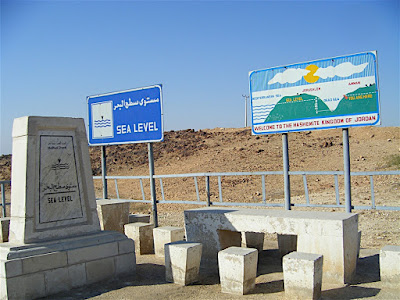
Getting from Jordan to Israel involved getting into a cab in front of our flat and telling the guy to take us to the King Hussein bridge, because we wanted to go to Jerusalem. He says 20 ($28) dinars and we are like, OK, good deal. So as he's driving we try to engage in the normal Amman taxi banter, but he doesn't really have any english. After about ten minutes, we notice that we are going the wrong way and start to try to ask questions. Eventually he pulls into some parking lot and says "shigrug salem, akasikia Hussein." Like, we're here. Ann and I groan and say, no , we want to go to the King Hussein bridge, and he asks a couple of people in the parking lot of this place, it looks like a community center or something, if they speak english and then eventually some guy pokes his head in, we tell him where we want to go, and the taxi driver takes off. About 3 dinars later he pulls into the bus stop, and there are a bunch of taxis. These guys speak english and they want to take us to the King Hussein bridge for 20 dinars. Meanwhile our cab driver wants 4 dinars for the wild ride over here. So far we are about 40 minutes on the road and about 5 minutes from our flat. We give the guy 3 dinars, and hop in the cab for Israel. After about 10 minutes in this cab, we pass right by our apartment. Big circle. Eventually we get down to sea level:


Finally get to the bridge, the cab drops us off, and we go through the whole ramshackle chaotic customs rigamarole. We miss the bus by about 30 seconds, while buying our exit stamps from the duty free shop. Guy says next bus in 30 minutes. Two hours later, we get on the bus to Israel. Now we cross the King Hussein bridge and then the Allenby bridge and we are in the West Bank. There is no line, just a crowd, to get our luggage thru the check point and we jostle up to the front and push it through and then go through an xray machine and then there is some air jet thing that not everyone goes through and then finally we get to wait in line for about 1 hour as the Israeli customs officials grill various people on their grandparents names and what they are doing in Israel. All kinds of people cutting in line all the time. Except the obvious tourists, like ourselves.

Ann has briefed me on what to say and what not to say. Like "Do you know any Palestinians?" Answer "No." "What, you live in Amman, which is 90% Palestinian, and you don't know any Palestinians?" "No." You know, obviously we do know some Palestinians, but the secret truth is that they are Jordanians, therefore this is not strictly a lie. Also, we wanted the stamp to go on a piece of paper, not our passport, otherwise Ann wouldn't be able to work in other Gulf States. Sometimes the Israelis will do this, but we had recently heard that they wouldn't. If they didn't, we'd just have to turn around and go back to Jordan. That was another thing Ann briefed me on. The main reason she couldn't get an Israeli stamp was for work, because she is technically overseeing the office in Syria. But we couldn't say Syria, because that would make the whole thing harder, we would have to say she had work in "some other Gulf States." I've noticed that dealing with borders is a lot like dealing with people who have borderline personality disorder. If you say the wrong thing, the reaction can be totally out of proportion. Not that I know anyone with borderline personality disorder (at least no one reading this).

Anyway we get up to the passport person (all of them are women) and first we ask if we avoid having our passport stamped. She says "No, it is impossible." So I say "Well, then we can't enter, can we have our passports back please?" She kind of waves at us and says "One moment, one moment.." Asks us why, makes a phone call and then says "Maybe we can do this for you." The one thing she got stuck on was my middle name, Kazis, which is very similar to a palestinian name. She asked me what it meant, and I didn't know but thought it might mean shoemaker (later I realized that was what the last name of the person I was named after meant, Kazis Krauchunas). Ann interjected "It's Lithuanian," and then the passport lady said "OK" and we got thru. We were in Israel. 50 kilometers from our apartment and it took about 6 hours. Not bad, really, considering the Israelites took 40 years and Moses never quite made it.

Right when you cross the border it looks pretty much like a desert without any scrub. You're still pretty far below sea level and a lot of it looks like the badlands. Around this part you sea some shacks made of plastic and corrugated metal with sheep pens. Like one every couple of miles or so along the road. Once I saw the sheep pens I could see that there was a little bit of green on some of the desert hills, just a very dim shading, like a green 5 oclock shadow. As you come up out of the valley, you see these walled developments, which look like big castles, situated in the upper reaches of the hills. The West Bank. Here are the text message Ann and I both got from Orange,Israel, when we entered Jerusalem:


Huh?

Wednesday, November 14, 2007

Dead

So, we've been in Amman for a couple of weeks. Ann is settling into her job, and I am getting my office situation. The Iraqi refugees have added somewhere from 1-10 billion dollars to the economy here. There are poor and rich refugees from Iraq, and many of the rich ones are here because they got rich helping the US. I was just reading this other very interesting account of the arrival of Iraqis here and will just provide the link so I don't have to repeat anything.


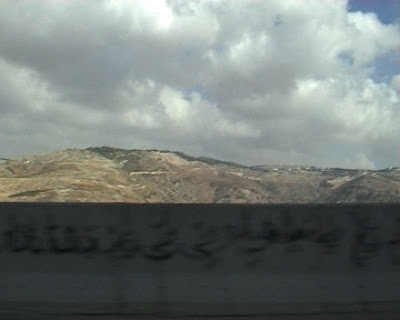
You can look across from the Dead Sea in Jordan and See Israel. They call it Lot's Lake, here. The west bank. From the road:


Two different guys speaking arabic rubbed slime on my back. One guy asked me if I knew why this was the lowest point on earth. "Is it because this Sea and this valley sits on the crevice between the Arab and African plates, and they are pulling apart, creating the Great Rift which extends 3000 miles to the south all the way down to Tanzania?"

"No," he said, "Wrong wrong wrong wrong. Nothing to do with geography! It is because the people turned away from God for 500 years, and they invented being gay, and the angels came and told them to stop and when they didn't Gabriel lifted up the land that Sodom was on and turned it upside down."

This from a guy who came up to me with a gob of greasy mud in the Dead Sea and started rubbing it on my back., purring "this will make you skin like a six month old baby!" And the mud is very effective. Ann tried it out first.


But it still doesn't make sense to me that if you turn something upside down, it gets lower. Take a shovel, stab some dirt, turn it upside down in the same spot, you have a high spot. But if you think that way you confuse reason with theology. Observable fact with legend. And you might begin to confuse the promised land with a desert.

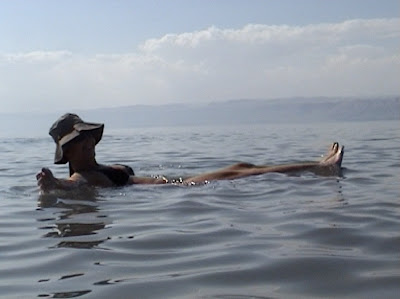
I remember going to the great salt lake. It was supposedly pretty floaty. The Dead Sea is hyper floaty. We were floating in six inches of water, here:


The music that we hear everywhere is Lionel Richie (worshipped), Bryan Adams, and Celine Dion. Cheese factor generally high.

Friday, October 26, 2007

Ann in Amman in na

Trying to make a palindrome out of the title.

We went from Dar to Zanzibar to meet my parents and Mimi, who had just come off of a Safari in the Ngorongoro Crater and places. They had a great time, saw cool stuff like hyena's feasting on bloated hippos and a lion in a tree.


In Zanzibar, I pretty much saw every dawn and took video of every one except the last one, the spectacular one. Then me and Dad would go on a run followed by a hop in the pool.


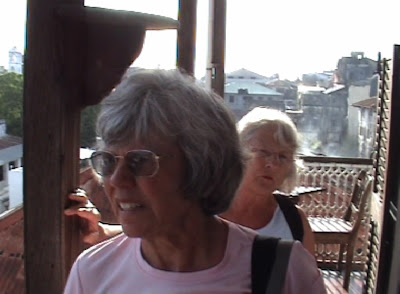
We also took a quick tour of stonetown one day.


From there, Ann and I went to Amman stopping in Dubai enroute. It struck me, as it has many times while traveling, that my American perception of other countries is so wrong. I remember going to Kuala Lumpur, and having this perception of Malaysia as a jungly place, which it is, but the two tallest buildings in the world are there. That city is ultra modern and ordered and there are certainly things they have figured out about running a civilized city that the US can't get together. This same realization dawned on me as we walked through Dubai airport. It had a 5 star hotel that you could spend your layover in (hourly rates) and was a bustling supermall with a health club and everything. Walking around in there, I was surprised at my surprise, because I've seen pictures of Dubai. But my American lens clouded the fact of Dubai's ultra modern character, as it had Kuala Lumpur, until I actually saw it.

I wonder if there is a way for people to get this without going there.

From Dubai, we went to Amman, Jordan.


A big sprawler of a city, with all kinds of topographic extremes.

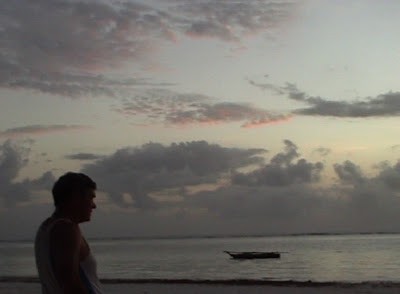
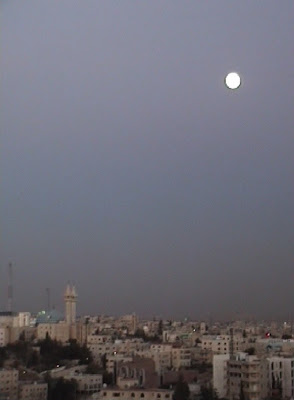
Looking east from our hotel room. Full moon.


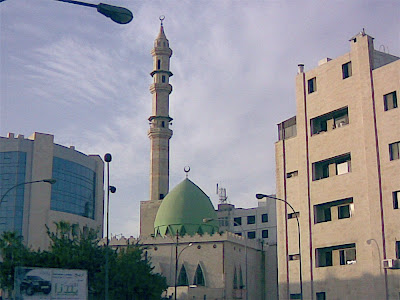
Seems like all the buildings are made of white or cream colored stone, or stone-like concrete blocks. Makes it look cool at dawn and twilight. So far, we haven't seen much, took a taxi downtown and to some of the ruins. I walked around for an hour near the hotel, without coming to a single stoplight or crosswalk.

A lot of the buildings look like mausoleums.

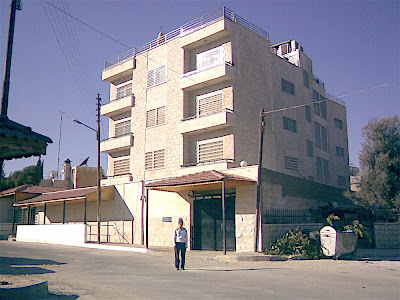
Here's Ann in front of her office.


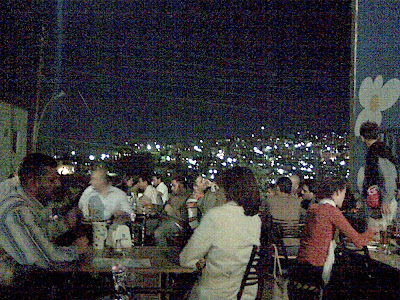
We managed to go out once before both of us got some weird flu that had us both waking up in the middle of the night with intense rib cage pain. Here's a shot looking west from a rof top coffee shop:


Tuesday, September 4, 2007

Mrs. Todo Cokfect's wild ride II

Mrs. Toad's Wild Ride II

After saying adieu to the next batch of fugees to head for American soil I made my way to my trusty haunt the Jacaranda Hotel. I have stayed there now four or five times and this time I decided, after one night spent mainly on the pot, that it was time to upgrade in light of Amers visit.

The Jacaranda's frayed blankies and lack of decent water pressure were ok in the beginning when I was a bright-eyed relief worker but now that I have tasted the good life in Dar there was no going back. I made my way to the oasis that is the Nairobi Holiday Inn and secured our spot. At around 7 I made my way to JKIA airport and waited by the gate jostling against the aggressive taxi drivers for a view of my twin descending the stairs.

Finally she emerged from the surging tide of humanity and we had our tearful and giggly reunion-reminiscent of our other greetings when we had been apart in foreign countries-London Heathrow, Kuala Lampur, Tokyo and of course SFO and Denver.

Despite the fact that it is 'winter' the weather in Nairobi was beautiful. It was fun to see Nairobi at night through Amy's eyes-'terrifiying'. Nai-robbery as it is unaffectionately known is best seen in the daylight when your chances of getting carjacked-while still astronomical-are diminished.

We headed to the bar and had a celebratory Tusker-the local boozy fare-and got caught up. Every few minutes a 'holy shit I can't believe I'm/you're here!'. As this warm fuzzy reunion unfolded something else was unfolding in my innards.

Until this time I had prided myself on the fact that despite eating greasy roadside donuts in Kibondo I had experienced nary a runny stool. Now the stools they were a-runnin. As was a fever. This started to seem serious. The next day Amy got to see the IOM medical facility as it seemed important to make sure I didn't have malaria or cholera or one of the many other diseases that start to appear in your vocabulary on a regular basis when you live in Africa.

The doc didn't like the way I grimaced in pain when she touched my abdomen so she sent me to the clinic. Amers was a trooper. We had hoped to visit the animal orphanage so she could meet my friend the cheetah but instead, we spent the rest of the day stuck first in Nairobi traffic and then in the waiting room with hacking children and sniffling Somali refugees as we waited for me to get my blood drawn. Welcome to Africa sister!

Then came the news-the blood test was inconclusive. Could I give a stool sample? I might have been able to provide a watery squirt but the 5 Immodium I had swallowed in a panic had had the desired effect and there was no way I could produce for the doe-eyed lab technician. Amy, more schooled in third world living than I, recognized that her weekend would be spent dealing with poo if we didnt make this happen and urged me into the bathroom with the little plastic match box with the universal biohazard symbol on it.. No dice.

Doe Eyes said it was ok, go home, send later. Amy in her infinite wisdom asked for a q-tip. Whilst unpleasant, something appeared and we cheered. A few minutes later Doe Eyes came back shaking his head, 'Pole Sana not enough'. Gaaaa. When Amy asked for a lubricant I had to put my foot down. My anal probing was done for the day.

It was not gonna happen. We decided to go back to the Holiday Inn and try our last-and most trusty resort-Chardonnay. Now this might not seem like a good idea to most people--but most people aren't Strandoos. Outside of Ballard anyways. The Chard did the trick-hurrah! I managed to squeeze out a brown portion the size of the last joint in my pinky, secure it in its biohazard emblazoned container which was then concealed in an innoccuos Holiday Inn plastic bag.


The sample was sent off to the lab with my favorite taxi driver in the whole world, Daniel.

We went to bed satisfied with our accomplishment (mine really) and woke to a new day full of the promise of answers to this nagging question of 'salmonela, ghiardia, parasite...?' I got a call from trusty Daniel telling me he was in the lobby and could I meet him right away? When I got to the lobby he was seated across the room on a sofa and with an apologetic (but wry) grin. Slowly, he held up the bag that I had given him the night before (Me: 'um it's a blood sample for the lab,,,' ).


Well my boy Daniel made his way to the clinic alrighty but of course I wrote down the wrong clinic so by the time he found Doe Eyes it was too late. 'Not fresh' was Doe Eyes' verdict. We both dissolved into giggles as only two people who have shared a stool sample debacle can. I retrieved the bag and asked the haughty receptionist to dispose of it for me (HAW!) .


At this point I decided to continue with my current (as of night before) regime of Chardonnay,Nachos (the first in five months how could I say no?), and Amy's Arythromiccin. The combo had a winning effect.

We took a day trip to Nakuru, the place where Reed and I saw a cold-eyed Leopard consider his chances. Amy and I saw Rhinos (white and black), the millions of flamingos on the lake, baboons (those red bottoms-ew!), lions (ok only their swishing tails as they were all asleep) a leopard (again only a dark shadow in a tree), giraffes, and the usual warthogs (so ugly! but endearing) and all the other bushbacks and buffaloes that dot the landscape.

In more true Strandoo fashion we forgot a camera and binoculars and could only giggle jealously at the other tourists with their telephotolenses. We bought a camera at the gift shop and after the shopgirl had dusted it off (phooofff!) we loaded it with another relic of the 90's-film-and proceeded to take a roll of film mainly of bushes that we accidentally exposed later (culprit-Chardonnay).

In the morning Daniel picked us up for the airport (more embarrassed yet conspiratorially giggling) and we made our way to Mwanza, a small city on beautiful Lake Victoria where we embarked on the next leg of our Tanzanian adventure.

One bonus was that we had a few hours in Dar es Salaam where we had enough time to have Gerard my next favorite taxi driver in the whole world take us to the Irish Pub at the Peninsula Hotel for lunch so Amy could see another favorite haunt. Dar is a beautiful seaside city on the Indian Ocean and a breath of while not so freshy fresh air a different scene from Nairobi. We sat overlooking the the Indian Ocean, a beautifully restored dhow in front of us, the Masai guards in all their glory and cell phones on their ears) and had a quick lunch before setting of for Mwanza.

Mwanza airport is a tiny airstrip and we found a quick bite. We were hounded by bees and amused the locals as we constantly jumped out of our seats and swiped unsuccessfully at the African bees.

The flight from Mwanza is on the UNHCR plane-a twelve seater that goes direct to Kibondo. I told Amy that if I had to draw a graph of entry into Africa Nairobi-Dar-Mwanza-Kibondo is the prefect gradulation. Kibondo is in the middle of nowhere in nowhere. Recently when Reed was in Dar he was told by a guy who grew up in Kibondo. "Man' he guy said, 'Thats like living in Africa within Africa!'.

The airstrip appears out of nowhere, we get picked by the LandRover, and tarmac is a thing of the past. Its all villagers in bright kanga clothes and buckets or firewood on their heads, goats, long horned cattle my jogging nemesi). The next few days were spent at Kumwayi where we live-exploring the countryside with the hordes of kids following-thrilled to see yet another white woman-this one even more white if thats possible! I worried Amy would be bored but was reassured that she relished the down time as she explained that she hadn't been able to read her mysteries and snooze al day long in three plus years. We gushed over photos of Gunnar and Tove and got caught up on their latest exploits and developing vocabulary.

We spent the week in Kibondo, not realizing that the ordeal of getting in would be trivial compared to the logistics of getting out.

Saturday, September 1, 2007

Mrs. Todo Cokfect's wild ride

Ann went to Nairobi to meet her twin, Machacha (swahili), and from there they had work to do. The kind, you know, where you repair the damage that distance has done. She boarded the flight with the refugees from kibondo and promptly broke out into a cold sweat.

This is called escorting the refugees. You show them how little there is to worry about, even though, for the first time in their lives, they are placing all of their faith in a technology that, up until then, has offered them only noise in the sky.

So Ann boards the plane, gives thumbs up and smiles, and in Mary Lou tradition, crosses herself and leans back, glancing over to the window. Then she notices the movement around her and turns around, to see that all the refugees have begun crossing themselves and one taps her on the shoulder and asks if it is OK if they begin singing hymns. And so, as the plane rises, so do the voices of the free. Their songs say goodbye to Tanzania, the country they appreciate but where they have never been free, and the joy adds lift.

Everytime there is turbulence on this short flight, Ann yells Sawa sawa (it means OK, OK in swahili) and the restlessness settles. Meanwhile, in the belly of Ann, a different turbulence threatens her equilibrium.

Ann says,

"As the flight descended into Nairobi many of the passengers became restless. One of the passengers who spoke french said to me ' this is our last view of a developing country.' When we landed in Kenya they thought they were in America. I explained that they were still in Africa as I escorted them through the airport. It struck me then that they were on the way to their new lives in Las Vegas and Mobile and Boise. Places I was their notable authority on. Places I had never been.

How do I even explain my saying goodbye to them. Parting ways. Giving out my email address to everyone. saying "tell me when you get there". Knowing or not knowing what lays ahead of them. They with their plastic bags containing all of their belongings. They say, "You are not going with us all the way". Ann says, "Everythings going to be OK. OK."

And, "Someone like me will be on the other end."


She always tells them: "You have survived this long in the refugee camps. Its going to be hard, but not as hard as it was there. If you have survived that you will survive this. "

There is something stronger in some people. Once you arrive you will see that you have this thing. There will people that help you who have seen this thing. It is a thing outside of you, attached to you but not yours. It is important. You will forget it. Still it remains a part of you. You will remember it.


there wil be people to help you.....but it will b e hard. Its hard to

Meanwhile, Amy's plane begins its descent.

Monday, August 20, 2007

Dar Kibondo

Late July, TCRS (http:\\TCRS.or.tz), invited me to Dar to do some consulting. They needed a backup for their small network and some other things that I could do and they were willing to fly me over there and put me up. Sweet! A trip to the big city.

So I set up a computer backup in Dar for TCRS and it took about a week, It's not complicated to do that kind of stuff, but it's not easy. It's not cheap, but if it is cheap, it's sketchy.

They have these deep ditches where run off and garbage collect. I see kids in there with nets catching minnows and also somewhat larger, dollar sized fish.


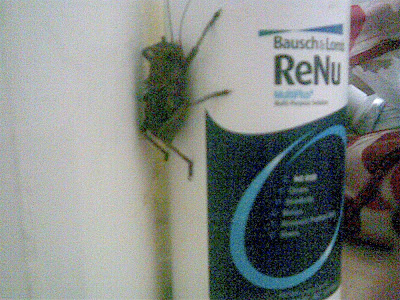
Ann called me In Dar and mentioned that she went running, and when the usual 20 kids were running behind her, she felt something in her shoe. She thought it was one of those plastic seals from a water bottle so she took her shoe off and this bug (I took a picture of it in the bathroom before leaving) drop out. Still alive:


After Dar, the trip to Kibondo consisted of a flight to Kili Airport, 2 hours layover, ad a flight to Mwanza, followed by a 6 hour ride to Kibondo.

At Kilimanjaro International Airport, I had a 2 hour layover. Ended up hanging in the departure lounge. The first thing I noticed was this poor little bird on one of the end tables.


I was at the airport there in Kili, and I sat down in the departure lounge, such as it is, and noticed immediately two things. 1) Only I and one other person (the guy I sat next to) were sitting in the departure lounge. 2) there were dead birds along the windows. At least ten. I just said aloud, "What's with the dead birds?" the guy next to me, a german who had just climbed kili says"Welcome to Africa".

The way the airport is set up is that here in the lounge, the ceiling is open in the middle, with some traditional looking straw roofing edging the square hole in the middle. But the glass of the lounge is facing the tarmac of the airstrip. So you end up having a ton of flies moving down the chimney of the hole in the middle to score food particles from the humans waiting to fly. These flies then apparently forget how they got in and spend the rest of their short, full bellied lives, banging into the giant windows that offer such a resplendant view of the mountain and the planes TAKING off in front of it. Then the birds come down the chimney and bang into the glass at full speed, maybe trying to get the flies.

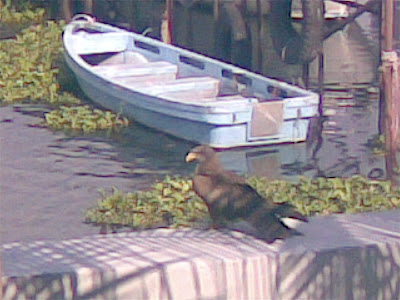
From KIA it was to Mwanza, the last part of my flying journey back to Kibondo. It was a car from Mwanza on. I got a picture of this eagle with my cell:


Mwanza is a pretty big city, but until now I've only ever seen the Tilapia and the road to the airport. At the Tilapia, you get a lot of mining folk, because the Gaeta gold mine is a couple hours away. When they are talking about the environment, they are talking about changing it. I'm sitting in the restaurant hearing these South African accents and thinking about how Leul mentioned that they used to pay some of the miners in opium, and how these guys would end up injured or something but die from withdrawal in the hospital. Or the mine would close down and they'd become criminals, junkies looking for a fix. I don't think that is the case with the Gold mine near here, Gaeta, but when I get around mining talk, that's the kind of stuff that pops into my head. It is hypocritical of me to have this negative feeling about mining, since I enjoy the fruits and would suffer without them. I assume an air of affront, magically mitigating my part in exploiting the environment and adding to humanity's suffering.

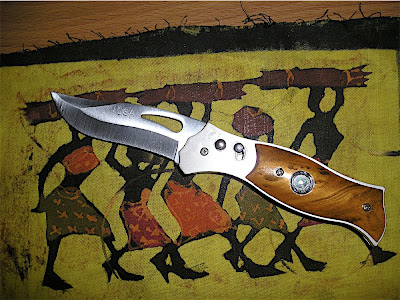
The car sent to take me back to Kibondo had some errands to do, but picked me up promptly at 8:30. Then I sat in the car for about four hours as we picked up various things in Mwanza. I bought this cool knife for 3,000 shillings:


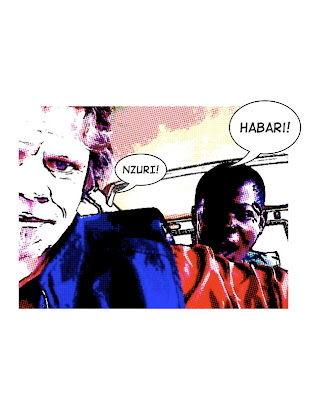
One other passenger was a little girl named Salome. She helped me learn a little swahili and I made a comic:


At one point on the road, we followed this container truck for about 50km and this guy was hanging from it, catching a free ride. It was a little scary to be too close to him, because if he fell off (I saw his feet slip a couple times) he'd be hard to avoid. He made it, though.


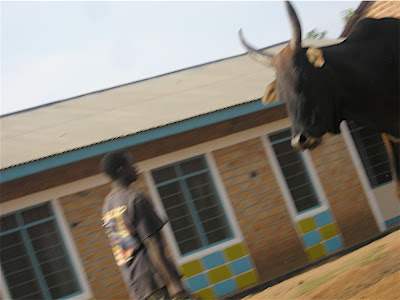
On the drive back from Mwanza to Kibondo, I mostly slept as we cruised for 6 hours or so. Many towns have a "barricade" at the entrance, usually consisting of a long wooden pole precariously balanced on a couple forked sticks in the ground. The car rolls up, and a kid in a uniform comes up and maybe walks around the car, maybe makes the driver sign something, ad then slides the pole out of the way and motions the car onward. We came into one town and the barricade was askew, so the driver kind of slowed down, and muttered something about "no police" or something, and then we rolled through town. After about 50 meters, I see this guy with an orange vest on, in the middle of the road, waving us to the side. I'm thinking, "oh, here's the cop," but the drivers says something like "this guy!" and swerves around him. Only then do I notice that the guy is barefoot, has no shirt on under his vest, is wearing cut off jeans with the fly open and has a ruined grin and crazy eyes.

THere are these storks, called Maribou, that get to be 4 or 5 feet tall. They eat anything, and sometimes you see them around dumps and places that smell bad. So we are still rolling through this town and this guy with a big nose and a trench coat comes strolling out of the crowd of villagers to the side, right into the road in front of us. The driver honks, and the guy starts running ahead of our car and then spreads his wings and takes off. It was a Maribou, but they are so similar in proportion to people that my eyes tricked me at first.

So, back in Kibondo.


kibondo mump


Wednesday, August 8, 2007

Bye Bye Buja

Take a picture of this:

You are in a cab with clogged fuel injectors crawling its way across a third world tarmac road. It is two and a half hours before dawn. You're in Burundi. A country at peace, yes. But Peace lays across this land like a grandmother's shawl across the shoulders of a fitfully slumbering grizzly bear. Its dark as the cab rolls to a stop, but you can still make out the barricade in the mountain road and the cloaked figure coming towards you. You might begin to wonder if you will catch that flight seven hours and a country away. That's if you're an optimist.

Turns out the military keeps the road closed until seven am. But we will definitely miss our flight if we have to wait. The soldier speaks french, kirundi and some swahili. Vic, who I'm travellng with, speaks about as much french as I do swahili, maybe a slow toddler's vocabulary. Our driver, Ray, speaks swahili and a little english. Fortunately, there are bridges that reach across the language barrier, and they come in denominations of a thousand here. Ray gets out of the cab, leaving it running, and follows the askari back and out of our sight to engage in some cultural exchange. The car starts rolling backwards. I'm sitting in the back, so I reach forward and yank the emergency brake. Of course its useless, and we roll a little further before I hear Ray cuss and grunt, stopping the car's rolling with the help of the askari. They continue their negotiations leaning against the trunk of the car. Then the soldier strolls back into the darkness, Ray gets in the car and says "Bossi." Meaning the soldier went to get his superior. The superior comes back, Ray puts about $5 into his hand, and the barricade is raised. We are on our way.

As we start moving up the road which winds up through the mountain range bordering Burundi and Tanzania, I'm thinking about a few safety issues. For one, I am wondering why Ray took the tire off of the left rear wheel and replaced it with the donut spare while we were in Bujumbura. We had him put the real tire back on, it had less tread than the donut but still had good pressure, but I'm sure Ray had a reason he didn't or couldn't communicate to us. As it turns out, it was a pretty good reason. I'm also wondering about the emergency brake, which is pretty handy to have on steep mountain roads with a drop off to one side. But, what the hell, its Africa, I think, looking at the fading dashboard light and listening to the music on the lone cassette tape we had for this journey, wondering for the 20th time if the singer is really saying "I wanna be your body lotion." I'm soon lulled to sleep by the soft roll of the utterly spent shocks and the rattle of the doors.

When I wake up, we're in Mbanda. Still in Burundi, but this is where we encountered the time bending customs agent, who took our money so slowly when we entered Burundi that it seemed painless, like that parable about the frog in boiling water. It's before 7am, and there's guys walking around the customs office in towels with cups of coffee. Two offices are used as offices, the other two are rented out as bunk houses. No one we see seems to work here, and they all seem a little amused. Amazingly, one of the kids in a towel opens the actual office and beckons us in. Then he gets dressed and returns and we get our exit (Sortie) visas stamped and are on our way. We cross the Burundian side of the border no problem and then go through the neutral zone, the actual line on the map, which is a road going through a forest of Eucalyptus trees 60 feet high planted in a grid. By the time we get to the Tanzanian side it is about 9am. The immigration office here is under construction, getting a new roof, and there is rubble everywhere. One of the construction workers goes to wake up the official, and he meanders over, beckons us inside. As we are ducking under scaffolding and dodging around chucks of concrete in the hallway, I see a pile of Tanzania drivers licenses on the ground. We get into his office and exchange greetings, and then it turns out my visa in TZ was a single entry visa so he wants $50 for a new 3 month visitor visa. This brings my total cash on hand down to $50, plus 12,000 burundian ($12).

By the time we are allowed back into TZ it is 9:30. We've got a plane to catch in Kigoma, about two hours away, that leaves for Dar es Salaam at 12:15. Hakuna Matatiso (No problem). Vic keeps telling Ray to go faster, but Ray seems to ignore him, cruising slowly on the flat parts and taking his time on the slight grades. Downhill, we go fast enough.

About a half hour into TZ, we come to a complete stop, and Ray keeps revving the engine, but we don't move. Some long horned cattle cruise by on the right, and Ray shuts off the cab. We get out after the cows go by. We are on a ridge about 200 meters wide, which drops into a valley on either side about 1000 meters. Two taller ridges envelop this one. The place feels remote. Ray pops the hood on the car and as I study his face the place begins to feel more remote. I go start the cab and he starts pulling plug wires to see if they are sparking. He thinks we are losing power because not all the cylinders are firing, something I've seen before with our VW bus. It looks like all the plugs have spark, though, which means there's probably a fuel flow problem or air/fuel mix, ie. something not fixable with a crow bar and my computer tool kit. I'm thinking, remoteness-wise, siberia or the open ocean. Yeah, so now I walk around the car, remembering the donut spare we changed to a real tire in Buja, and both rear tires are looking very bad. The one I was worried about, left rear, is about half pressure. The right rear one is totally flat. No signal on the cell. Nowheresville is a sprawling metropolis and this road doesn't go there.

Vic gets out of the car and starts talking about the fuel pump and I'm trying to remember all the things we did to try to get the VW to go. We turn off the car. Ray puts the donut on the right rear tire. Three bicycles and a 60 year old lady with a sack of rice balanced on her head pass us. Its 10:15am. Time is behaving like a ho, spending herself on nothing good.

At 10:30, we start the car and it struggles up this slight grade and rolls down the next hill. We are about 50 kilometers from Kigoma. We could call a cab from Kigoma to come and get us, but still no cell signal. Everytime we get to a flat part or an incline, Ray has to rev the engine and pop the clutch. We lurch and glide, the engine dies, Ray hits the brakes and starts the car, revs it and pops the clutch. rev-pop-lurch-glide-stall-brake-start. Like that. Theoretically, we are coming down out of the mountains, but there are still a lot of inclines. At one point, we are on this one lane bridge in a little valley, and the car gets the front tires off the bridge, but will go no further. The rev-pop gets us no lurch glide, the brake comes late, and we start rolling backwards, actually passing someone on foot going the other way. 11am and most of our hope is about 15 minutes behind us.

I try to remember all the tricks they say to try when you lose power. Its probably the fuel injectors clogged with the dust, or the fuel pump failing, as Vic says, or possibly the fuel filter, although Ray says he changed it in Buja. We cold get the fuel filter off and blow through it the other way, but before I get gasoline on my lips, I remember something about cleaning the air filter. So I ask Ray if the air filter is clean "It's fine, fine" Yeah, right, so I pull it out and it is totally clogged with a gunky oil. Knocking it out is a sad waste of time, so Vic yells, "we don't need it, throw it in the trunk," and he gets in the driver's seat."Close the hood, get out of the way!"

He starts the car and proceeds to rev-pop-lurch the car all the way up to the top of this particular hill, without even waiting for us to get in. We're running after the car, which is a pretty good feeling, considering that moments before people walking were leaving us in the dust, and catch it at the top of the hill, where its idling, as Vic is walking from side to side trying to get a cell signal. Still nothing. We all pile in and Ray says its another 20 kilometers to town. 11:30 am. Grim.

As we are lurching along now, I hear this sickening loud metal on metal kind of banging sound that I associate with a flat tire. I look at the faces of people we pass trying to get a reading on how flat the tire is. Not that it matters. Vic gets Joseph, our friend in Kigoma, on the phone, but he is out of town with his boss, unable to come to our aid. We give the cell to Ray and tell him to call us a cab to come and get us--no more minutes left on the cell. Vic's been using Ray's phone, and my battery's been dead for a day or so. But, I happen to have a celtel voucher. I give it to Ray, he dials someone, they get into some argument in swahili (his mechanic?), and then we see pavement. Once we pull onto it, you can hear the left rear rim on the tarmac making that noise. This car is done. We probably don't have time for a cab to come from town and bring us back to the airport. As we are pulling our bags out of the cab and Ray is looking down at the shredded tire and scratching his head, it seems like we should have a pistol or something to put that car down.

My last $50 goes to paying Ray the remainder of our agreed upon $250 round trip, and While Vic is finishing that transaction, a white pickup full of people pulls up and drops off a kid, who starts walking up the mountain road we just came down. I go to the driver and tell him our cab is finished and we need to get to the airport by 12:15 (15 minutes), could we please have a ride? "Of course", he says (Kwa Kweli!). He even lets us sit in the front seat. We learn his name is Father Gaspari, a catholic priest. I notice people paying him as they are jumping off the truck, and I ask Vic if he's got anything for the church when we get to our destination. He pulls out 5000 shillings ($4.37) and offers it to father Gaspari, our frigging savior. "No," he says, "I'm glad to help." I invite him to come by my place in Kibondo and say thanks, and, incredibly, Vic and I board the plane.